
6.8 KiB
在 BBC micro:bit 上學 Python
作:Alan Wang, Feb 2021
本指南採用 GNU 3.0 通用公共授權
關於本指南
這份指南不是替兒童而寫,而是有興趣使用 BBC micro:bit 開發板為媒介來學習 Python 語言的成人或青少年。
現有的書籍或網路教材,在談及 micro:bit 的 Python 教學時,多半著重在 micro:bit 的功能和相關的範例,卻鮮少深入 Python 的語言特色。這份指南的目的是借用 micro:bit 的硬體特色來介紹 Python 的重要概念,好讓學習者將來能將之應用在正式的 Python 程式開發。
至於 micro:bit 是什麼、為什麼現在要學 Python,這些在網路上已經有非常多討論,這裡就不再贅述。
閱讀本指南所需的準備
本指南會使用 2020 年 10 月後上市的新版 micro:bit V2,但大部分程式碼也適用於 V1。筆者推薦使用 V2,因為價格相近但規格更佳,有更多記憶體執行 Python 直譯器。
你也需要 micro USB 線以及一台有 Google Chrome 瀏覽器的電腦,就這樣。不須安裝其他東西。
Python 編輯器
打開 https://python.microbit.org/v/2 :
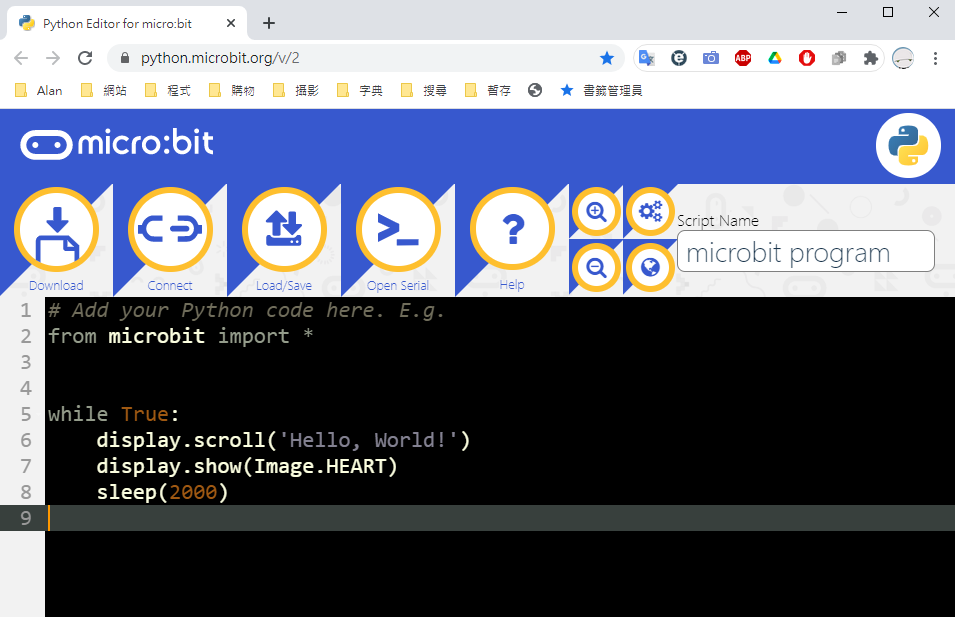
這是 micro:bit 官方提供的線上版瀏覽器,雖然簡單,但就本指南的目的來說夠用了。後面有機會的話,筆者會在談如何使用其他 Python 編輯器。
畫面上方有五個大按鈕:
- Download/Flash (下載/燒錄)
- Connect/Disconnect (連線/解除連線)
- Load/Save (上載檔案/存檔)
- Open Serial/Close Serial (打開 REPL/關閉 REPL)
- Help (線上說明)
按鈕的內容會因與 micro:bit 連線與否而有所不同。
與 micro:bit 連線和燒錄第一支程式/韌體
Python 是直譯式語言,這表示程式運作的地方必須裝有直譯器。幸好,官方編輯器簡化了這個流程:你從編輯器下載的 .hex 程式檔中,有一部分會包著 micro:bit 用的 Python 韌體,剩下的則是你寫的程式(又稱草稿碼)。即使你的 micro:bit 之前並沒有安裝 Python 韌體,只要燒錄一次程式就會自動完成韌體安裝。這也使得第一次燒錄──或者在使用過其他語言後重新燒錄──Python 會花較久的時間。
micro:bit 使用的 Python 實際上是 Micropython──設計給記憶體有限的開發版的 Python 版本。Micropython 本身就有好幾種版本,針對不同類型的開發板而作,不過它們都是是以 Python 3.4 為基礎。所以,Python 3.4 擁有的核心語言功能,在 micro:bit 都是可以使用的。
那麼,我們就來燒錄一支程式,直接用官方編輯器一打開就出現的程式即可:
# Add your Python code here. E.g.
from microbit import *


while True:
    display.scroll('Hello, World!')
    display.show(Image.HEART)
    sleep(2000)
將 micro:bit 接上電腦,然後按畫面中的 Connect,讓 Chrome 瀏覽器跟你的裝置連線:
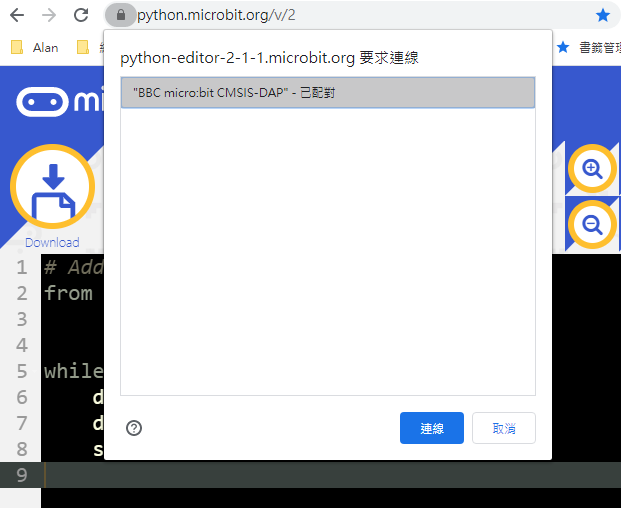
連線後按 Flash。等待程式燒錄作業結束。
較近期的 micro:bit 的韌體支援 WebUSB,讓瀏覽器能跟 USB 裝置連線,這麼一來編輯器就能直接下載程式到 micro:bit 上。現在市售的 micro:bit 應該都有新韌體了;但若你沒辦法連線,請用 Download 下載 .hex 檔後複製/貼上到 micro:bit 的 USB 磁碟區。
REPL 互動介面
想學 Python,就不可不知 REPL(Read-Eval-Print Loop,讀取-求值-輸出循環)。簡單說,這是 Python 直譯器的互動介面,能讓開發者用來做簡單的測試、探索 Python 的功能、讀取程式的回應等等,不管在電腦或開發板上,對程式開發者來說都是很實用的工具。因此後面在講解 Python 入門時,我們會先在 REPL 下來示範。
在 micro:bit 連線的情況下,點編輯器的 Open Serial,然後點按鈕下方右側的「Send CTRL-C for REPL」或直接在鍵盤上按 Ctrl+C。你應該會看到以下畫面:
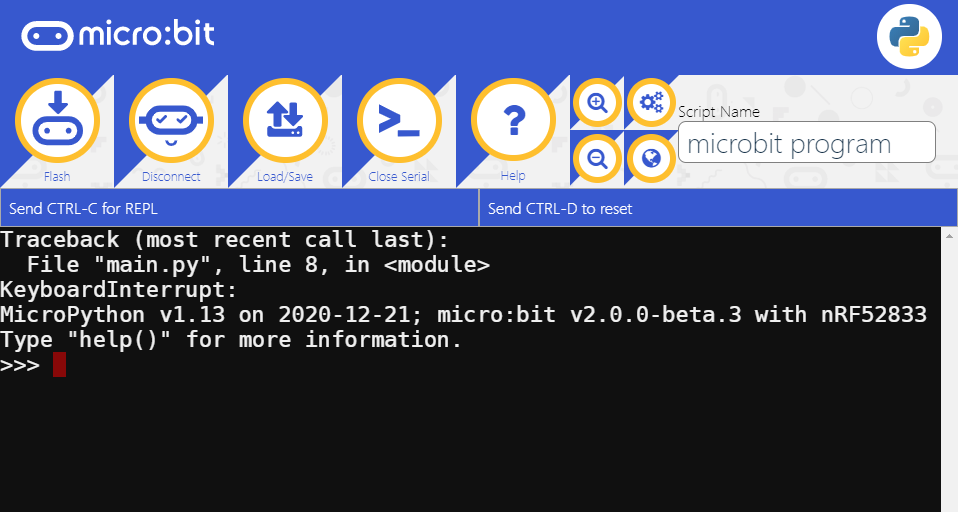
這幾行文字
MicroPython v1.13 on 2020-12-21; micro:bit v2.0.0-beta.3 with nRF52833
Type "help()" for more information.
>>>
就是 REPL 的提示,類似 Windows 命令提示字元或 Unix 的終端機。它告訴我們 Python 直譯器的版本,並等待我們輸入指令。
現在於 >>> 後面輸入 1 + 2,並按 Enter:
>>> 1 + 2
3
可以發現 Python 直譯器解讀了你輸入的程式,並自動算出答案。
現在,照 REPL 提示所說的輸入 help():
>>> help()
Welcome to MicroPython on the micro:bit!

Try these commands:
  display.scroll('Hello')
  running_time()
  sleep(1000)
  button_a.is_pressed()
What do these commands do? Can you improve them? HINT: use the up and down
arrow keys to get your command history. Press the TAB key to auto-complete
unfinished words (so 'di' becomes 'display' after you press TAB). These
tricks save a lot of typing and look cool!

Explore:
Type 'help(something)' to find out about it. Type 'dir(something)' to see what
it can do. Type 'dir()' to see what stuff is available. For goodness sake,
don't type 'import this'.

Control commands:
  CTRL-C        -- stop a running program
  CTRL-D        -- on a blank line, do a soft reset of the micro:bit
  CTRL-E        -- enter paste mode, turning off auto-indent

For a list of available modules, type help('modules')

For more information about Python, visit: http://python.org/
To find out about MicroPython, visit: http://micropython.org/
Python/micro:bit documentation is here: https://microbit-micropython.readthedocs.io/
這是 micro:bit 的 MicroPython 內建的訊息,包含一些簡單的指引。注意到這兒也提到了 Ctrl+C 和 Ctrl+D,前者是用來中斷 micro:bit 目前執行的程式(程式執行時不會出現前面的提示),而 Ctrl+D 是用來強迫 micro:bit 重開機,以便重新測試程式。
現在試試這個:
>>> help('modules')
__main__          math              os                ucollections
audio             microbit          radio             urandom
builtins          micropython       speech            ustruct
gc                music             sys               utime
machine           neopixel          uarray
Plus any modules on the filesystem
現在 REPL 列出了 MicroPython 中的所有模組(module)。之後我們會看到它們是什麼,以及要如何使用。
Python 的基礎:陳述/運算式,物件,模組
(持續寫作中...)